

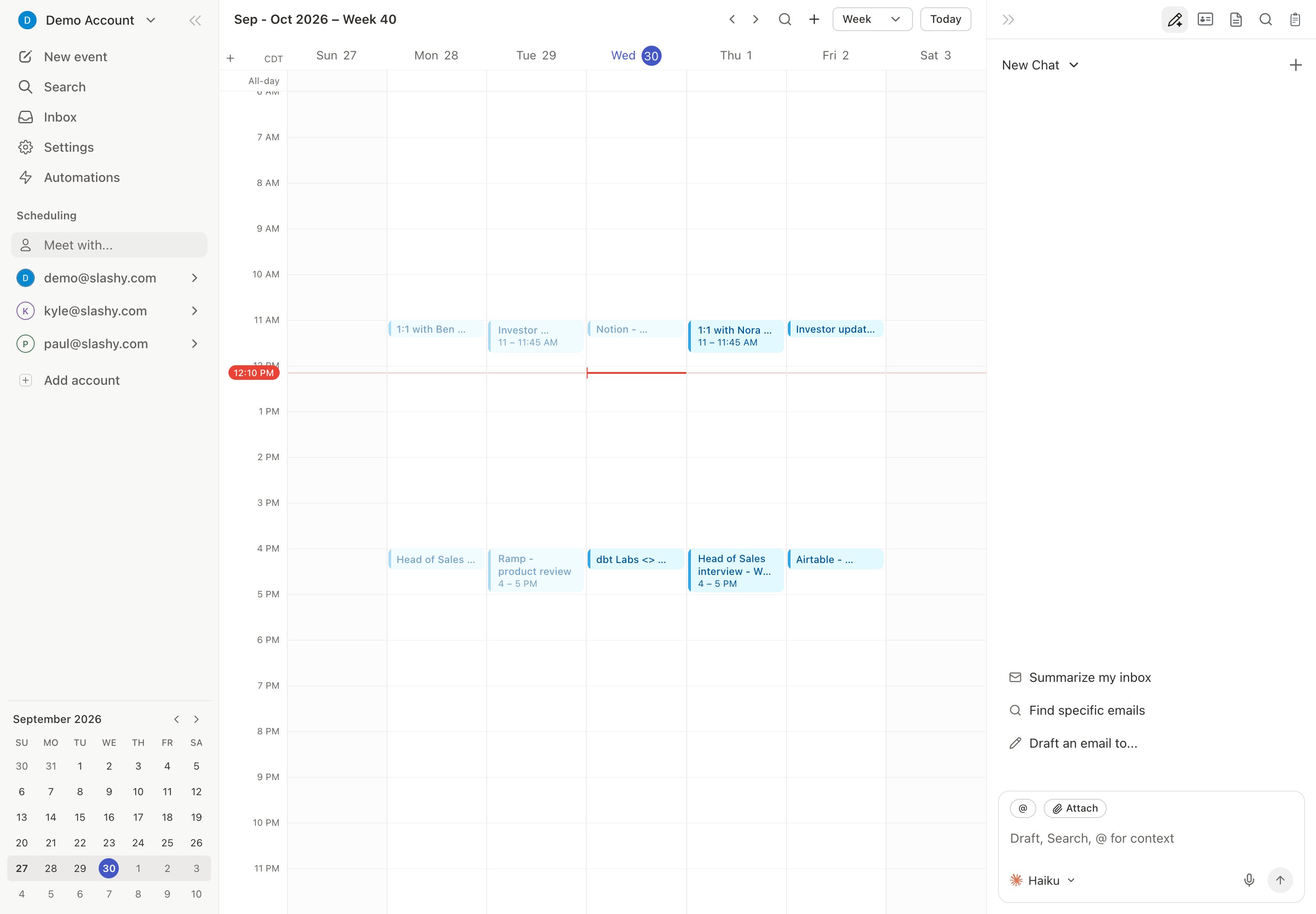
Anatomy of a Calendar Trigger
Every calendar trigger has three parts:- Condition — which events match (e.g., “meetings with external attendees,” “1-on-1s with my direct reports”)
- Timing — when to fire relative to the event
- Action — what the agent does (e.g., “prep me and send the briefing on iMessage,” “draft a follow-up email”)
Timing Options
The trigger builder offers three timing modes, each with a dropdown of preset intervals:“On event change” triggers (for reacting to reschedules and cancellations) are set up via the agent sidebar in natural language rather than the timing dropdown.
Creating a Calendar Trigger
You can create a calendar trigger two ways. Via the agent sidebar (natural language):1
Open the agent sidebar
Press
Cmd+/ or d a.2
Describe the automation
Example: “10 minutes before any meeting with external attendees, prep me and send the briefing on iMessage.”
3
Review and confirm
The agent creates the trigger with condition, timing, and action.
4
Manage in Settings
Find it in Settings > Automations alongside email triggers and reminders.
Meeting Presence Check
Triggers that fire after a meeting starts can check whether you’ve joined the Google Meet call:- Trigger fires N minutes after event start
- Agent checks Google Meet API for who’s in the call
- If you’re not present, sends an iMessage alert with the Meet link
Works with Google Meet links attached to calendar events. The agent can see who has joined, who is late, and who hasn’t connected.
Common Patterns
Troubleshooting Calendar Triggers
Trigger did not fire before my meeting
Trigger did not fire before my meeting
Check Settings > Automations to confirm the trigger is enabled. Verify the condition matches the event (e.g., “external attendees” requires at least one non-organization attendee). Also confirm Read Mode is off — it pauses action-taking automations.
Trigger fires for the wrong events
Trigger fires for the wrong events
Edit the trigger condition to be more specific. Instead of “all meetings,” try “meetings with external attendees” or “meetings with more than 2 attendees.” The agent uses the condition text to match events.
Meeting prep arrives too early or too late
Meeting prep arrives too early or too late
Edit the trigger timing in Settings > Automations. Use the timing dropdown to pick a different interval (5, 10, 15, 30, 60, or 120 minutes before event starts). For back-to-back meetings, 5 minutes works better than 10.
How Scheduling Works
Calendar triggers use timezone-aware scheduling. When you create a trigger, Slashy identifies matching future events and schedules invocations. As events are added, rescheduled, or deleted, invocations update automatically. When a trigger fires, the agent receives full event context — title, description, attendees with RSVP status, meeting link, and your action instruction.Related Articles
Email Triggers
Automate actions on incoming email
Scheduled Reminders
Schedule the agent for future tasks
Agent Autonomy
What the agent can and cannot do
Meeting Prep
Automate pre-meeting research and briefings